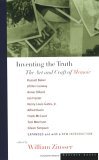
Toni Morrison ââåthe Site of Memoryã¢â❠in Inventing the Truth the Art and Craft of Memoir Ed

,
Open Preview

See a Problem?

We'd love your assist. Let the states know what's wrong with this preview of Inventing the Truth past William Zinsser.

Cheers for telling us about the trouble.

Friend Reviews

To come across what your friends thought of this book, delight sign up.

Community Reviews

 · 674 ratings  · 92 reviews
Start your review of Inventing the Truth: The Art and Craft of Memoir
julieta
Nov 01, 2018 rated information technology it was amazing
If you lot're looking for tips on writing a memoir, or just savor memoirs in full general and want to read what may be behind some, this is the book! I really enjoyed all of the essays here included, I am e'er reading nearly memoir writing, its actually one of my pastimes, and this will be included in my recommendations if anyone asks me over dinner for a good book on memoirs. If you lot're looking for tips on writing a memoir, or just enjoy memoirs in full general and want to read what may be behind some, this is the book! I really enjoyed all of the essays hither included, I am ever reading about memoir writing, its really ane of my pastimes, and this volition exist included in my recommendations if anyone asks me over dinner for a good book on memoirs. ...more than
Sharon Barrow Wilfong
In this anthology of writers' memoirs, we run into many different sort of writers, journalists, novelists, professors at universities who teach all sorts of things not necessarily related to writing but have all written a memoir of some type or other.

Each writer discusses why they wrote from the angle they chose. Russell Broil decided to narrow his memoir to his relationship with his female parent and her bear upon on his life. This meant leaving out most of his life, merely immune a straight line to accept the re

In this anthology of writers' memoirs, nosotros meet many different sort of writers, journalists, novelists, professors at universities who teach all sorts of things not necessarily related to writing just accept all written a memoir of some type or other.

Each author discusses why they wrote from the bending they chose. Russell Bake decided to narrow his memoir to his relationship with his mother and her bear upon on his life. This meant leaving out most of his life, but allowed a straight line to take the reader from A to B without getting side tracked.

Some writers had interesting childhoods. Jill Ker Conway, a professor, wrote nearly growing upwards in Australia. She shares what motivated her to write almost her complicated, personal relationships and the challenges of ascension through the echelons of a University as a woman.

Alfred Kazin writes of growing upwardly inside the Jewish civilization in Brooklyn. His objective is to get the reader to see every stoop, traffic sign and the smells coming from the restaurants and encounter the people brushing by on the crowded streets.

Toni Morrison believes everyone should look at their historical self, the bodily history and the perceptual equally a minority. She believes black writers accept two objectives: to say this is my personal history, but also the history of my race.

Annie Dillard doesn't believe in memoirs but rather that nosotros should use our personal experiences to write our stories, so, according to her, it follows that every story a author pens is actually a memoir on some level.

Each author offers their own perspective and insight in how to write about one's life or at least aspects of it.

Ironically, when I read samples of some of these writers' books on commercial sites, I didn't observe their writing very interesting. Which goes to prove that one can write well virtually a topic without necessarily living up to some other person's expectations of that topic.

This book however will be of interest to anyone interested in writing and receiving the ideas and thoughts of successful, published writers.

...more
Wendy
May 12, 2008 rated it it was ok
There are a few gems here -- the latter function of Annie Dillard's "To Fashion a Text" and Toni Morrison's excellent guide to the history of African American memoir: "The Site of Retention." The bibliography is likewise fascinating, to run into what writers were reading as they wrote their memoirs. Otherwise, this book hasn't quite made the transition from spoken presentations to published essays, and the production is neither solid craft advice nor strong personal essay. At that place are a few gems hither -- the latter part of Annie Dillard'due south "To Fashion a Text" and Toni Morrison's excellent guide to the history of African American memoir: "The Site of Memory." The bibliography is also fascinating, to see what writers were reading as they wrote their memoirs. Otherwise, this book hasn't quite made the transition from spoken presentations to published essays, and the product is neither solid craft advice nor strong personal essay. ...more
Michelle
Sep 17, 2014 rated it it was amazing
The sensationalism of TV talk show in the late 1980'due south brought a shift in autobiography that would create a new "memoir genre". The national fascination for featured topics relating to alcohol/drug dependency, depression/emotional disorders, attempted suicide, abuse/co-dependency, obesity/eating disorders, etc. Many authors of these memoirs bashed their parents, and/or centered on themes of further negativity, shame, victimhood, self-indulgence. Many of these memoirs would become international be The sensationalism of TV talk prove in the late 1980's brought a shift in autobiography that would create a new "memoir genre". The national fascination for featured topics relating to alcohol/drug dependency, depression/emotional disorders, attempted suicide, corruption/co-dependency, obesity/eating disorders, etc. Many authors of these memoirs bashed their parents, and/or centered on themes of further negativity, shame, victimhood, cocky-indulgence. Many of these memoirs would become international bestsellers. "Inventing the Truth: The Fine art and Craft of Memoir" (1998), William Zinsser takes a close look at the positive art of memoir expression by bestselling authors of that fourth dimension: Russell Baker, Mary Karr, Jill Ker Conway, Frank McCourt, Eileen Simpson, Alfred Kazin, Anne Dillard, Ian Frazer, Henry Lois Gates Jr., and Toni Morrison.

The authors discuss what makes the genre particularly successful. Readers experience a connection, observe inspiration and even nourishment. The writers reflect on the by, sometimes in hurting, but offering compassion/forgiveness. There is no self-compassion, whining, judgment, or hunger for revenge. A good memoir is advisedly crafted and constructed, it simply doesn't fall into place. The writer of whatsoever form must determine what to add and what to leave out, and has absolute command over the writing. There are both good memoirs and bad ones, they must be above all interesting, revelatory, and truthful.

Russell Baker stated: "Talking as well much for a writer is death". Jill Ker Conway avoided the re-creation of the "male myth", and stressed the impossibility of getting the unspoken truth from brief edited Television version of memoir. Frank McCourt stressed the value and redeeming quality of writing to educate while using entertainment/humor. Anne Dillard emphasized that memoir is not the place to air grievance, or for real/imagined attacks. Dillard doesn't believe in authors "kicking people around", or writing about those unable to defend themselves. As a writing instructor her input was potent and on chore. Ian Frazer discussed the first person narrative of family history, and "fake tiresome books" often associated with this theme, and how to make it more interesting for the reader. Toni Morrison wrote nearly the biographical slave narratives important in African American (Black) History. Likewise, the differences of self-reflection and the arts and crafts of fiction where the two genre'southward "embrace".

The authors provide additional insights on the titled books/memoirs they wrote, also an excellent resources that reviews books written in this time period. Memoir remains a popular best selling genre, this book is a highly recommended must read classic for all authors/readers. This title was available in eastward-book format at our public library.

...more
John
Jan 13, 2013 rated information technology liked it
More inspiring than actually helpful, INVENTING THE TRUTH is a collection of memoirs on writing memoirs. This INCEPTION-like premise works, non considering it'due south a peculiarly interesting concept, just because the volume's editor, William Zinsser, chose a group of extremely articulate and engaging writers for this compilation, writers who could discuss the gradual dehydration of paint and withal make information technology audio compelling. The volume is a collection of interviews, essays and speeches; most of the material i More inspiring than actually helpful, INVENTING THE TRUTH is a collection of memoirs on writing memoirs. This INCEPTION-like premise works, non considering information technology's a especially interesting concept, but because the book's editor, William Zinsser, chose a grouping of extremely articulate and engaging writers for this compilation, writers who could talk over the gradual dehydration of paint and still make it sound compelling. The volume is a collection of interviews, essays and speeches; nearly of the cloth is biographical or historical in nature, with just a small portion defended to giving tips as to HOW the writing of a great memoir is actually done. I tin't actually say I learned much from reading this, just it certainly imbues i with an overall infectious enthusiasm for the subject material--as well as for that of writing in general. Because how picayune involvement I normally have in reading memoirs every bit compared to other kinds of writing, it's impressive how well this book held my attention. ...more
Terry
April 19, 2011 rated it really liked it
I was enticed by the title, Inventing the Truth: The Fine art and Craft of Memoir, because I take been skeptical about the veracity of many of the memoirs I take read and felt that they contained considerable "invention". Every bit I read Zinsser on the unreliability of retentiveness and Bakery on the possibility that accuracy does non equal truth and fifty-fifty Dillard on the danger of using memories in a memoir, I take come to take and embrace the proposition that memoir has to do with truth which is not synonymous w I was enticed by the title, Inventing the Truth: The Art and Craft of Memoir, because I have been skeptical nigh the veracity of many of the memoirs I have read and felt that they contained considerable "invention". As I read Zinsser on the unreliability of retention and Baker on the possibility that accurateness does not equal truth and even Dillard on the danger of using memories in a memoir, I take come to accept and cover the proposition that memoir has to do with truth which is not synonymous with fact. I fifty-fifty found back up in Morrison's intimation that information technology might take fiction to get at truth. So, this fine, slim volume has given me a way to appreciate memoir, while still preferring to find truth in novels. ...more
Lise
April 07, 2012 rated it it was amazing
Lots of wonderful insight on the process of writing memoirs. My favourite excerpt below from Toni Morrison:

"You know, they straightened out the Mississippi in places, to brand room for houses and liveable acreage. Occasionally the river floods these places. "Floods" is the discussion they use, but in fact information technology is not flooding, only remembering. Remembering where it used to be. All water has a perfect memory and is forever trying to get dorsum to where information technology was. Writers are like that: remembering where we were

Lots of wonderful insight on the process of writing memoirs. My favourite excerpt beneath from Toni Morrison:

"You know, they straightened out the Mississippi in places, to make room for houses and liveable acreage. Occasionally the river floods these places. "Floods" is the word they apply, only in fact it is not flooding, but remembering. Remembering where it used to be. All water has a perfect retention and is forever trying to get back to where information technology was. Writers are like that: remembering where we were, what valley we ran through, what the banks were like, the light that was there and the route back to our original identify. It is emotional memory - what the nerves and the skin remember as well every bit how it appeared. And a rush of our imagination is our "flooding."

...more than
Susan
May 26, 2012 rated it it was astonishing
I like to write down quotes from books I like, and with this volume, I wrote down so many quotes, I just about copied the whole book. One of my favorite essays was from Toni Morrison, and she wrote: "If writing is thinking and discovery and selection and order and meaning, it is also awe and reverence and mystery and magic." I like to write downwards quotes from books I like, and with this volume, I wrote down so many quotes, I but about copied the whole book. One of my favorite essays was from Toni Morrison, and she wrote: "If writing is thinking and discovery and pick and order and meaning, it is also awe and reverence and mystery and magic." ...more
Jimmy
Jul 06, 2020 rated it liked it
Henry David Thoreau wrote 7 dissimilar drafts of Walden in viii years. He finally pieced together what Margaret Fuller called the "mosaic" method, a volume that strikes as casual and communicative.

Annie Dillard'south essay "To Style a Text" is the best. She says not to write a memoir. Rather write nearly what you are left with after years of thinking almost it. Her advice is "to manner a text. Don't hope in a memoir to preserve your memories. . . . The work battens on your memories. And it replaces them."

Dill

Henry David Thoreau wrote 7 unlike drafts of Walden in 8 years. He finally pieced together what Margaret Fuller called the "mosaic" method, a book that strikes as coincidental and chatty.

Annie Dillard's essay "To Mode a Text" is the best. She says not to write a memoir. Rather write about what you are left with later years of thinking almost information technology. Her advice is "to manner a text. Don't promise in a memoir to preserve your memories. . . . The piece of work battens on your memories. And it replaces them."

Dillard: "Afterwards you've written, y'all can no longer recollect anything merely the writing. However true y'all make that writing, y'all've created a monster. . . . Later I've written about any experience, my memories--those elusive, fragmentary patches of color and feeling--are gone; they've been replaced by the piece of work. The work is a sort of changeling on the doorstep--non your baby merely someone else'south baby rather like it, different in some fashion yous can't pinpoint, and yours has vanished."

Dillard: "Memory is insubstantial. Things keep replacing it. Your batch of snapshots will both prepare and ruin your retentiveness of your travels, or your childhood, or your children'south childhood. You can't remember anything from your trip except this wretched collection of snapshots."

Eastward. B. White once said nigh his move from Manhattan to Maine that he was "homesick for loneliness."

...more
Jo
January 24, 2020 rated information technology liked it
Read sometime between 2008 and 2010. Endemic a copy, reread some parts before altruistic in 2020.
I was really interested in how Angela's Ashes came to be, and in Henry Louis Gates' procedure writing Colored People (which I have since read). Reading Toni Morrison makes me want to revisit her work.
These were originally talks - I would've enjoyed going to them and hearing the authors.
Nancy
Sep 07, 2008 rated it really liked information technology
I honey Zinsser. I honey his writing, his thought procedure and his mind. His writing (included in this anthology) is planted on earth, graspable. He's an crawly editor as shown in this piece of work. The collected essays deal with the many considerations inherent in memoir. This anthology includes the piece of work of Dillard, Baker, Kazin, Morrison and Thomas. Dillard suggests that the re-writing of a memory will implant the edited version in the mind of its maker (71). Zinsser says, "Memoir is a window into a lif I love Zinsser. I dearest his writing, his thought process and his mind. His writing (included in this anthology) is planted on globe, graspable. He's an awesome editor as shown in this work. The collected essays deal with the many considerations inherent in memoir. This anthology includes the work of Dillard, Baker, Kazin, Morrison and Thomas. Dillard suggests that the re-writing of a memory will implant the edited version in the listen of its maker (71). Zinsser says, "Memoir is a window into a life" (21). Morrison equates memory to a alluvion, "All water has a perfect retentiveness and is forever trying to get dorsum to where it was. Inventing the Truth: The Art and Craft of Memoir Inventing the Truth: The Art and Craft of Memoir by William Knowlton Zinsser

My review
rating: iv of v stars
I beloved Zinsser. I honey his writing, his thought process and his heed. His writing (included in this anthology) is planted on world, graspable. He's an awesome editor equally shown in this work. The nerveless essays deal with the many considerations inherent in memoir. This anthology includes the work of Dillard, Baker, Kazin, Morrison and Thomas. Dillard suggests that the re-writing of a memory will implant the edited version in the mind of its maker (71). Zinsser says, "Memoir is a window into a life" (21). Morrison equates retention to a overflowing, "All h2o has a perfect memory and is forever trying to get back to where it was.
Writers are like that: remembering where we were…the calorie-free that was there and the road dorsum to our original place. It'southward an emotional memory…" (119).

View all my reviews.

...more
Tony Page
Dec 21, 2016 rated it it was amazing
William Zinsser declares in his introduction 'this is the age of the memoir'. He reports on a project begun in 1986 that produced this fascinting compilation from nine famous memoir writers describing their arts and crafts in their ain words. I couldn't put the book down. The following curt paragraphs summarise what I took away.

When the life history in your mind has not been critically analysed, and when the painful parts tend to grow and overwhelm the good bits, so the plot that guides your life is no

William Zinsser declares in his introduction 'this is the age of the memoir'. He reports on a project begun in 1986 that produced this fascinting compilation from nine famous memoir writers describing their arts and crafts in their own words. I couldn't put the book down. The following short paragraphs summarise what I took away.

When the life history in your listen has non been critically analysed, and when the painful parts tend to grow and overwhelm the expert bits, and then the plot that guides your life is not the one yous really want, and you might demand to do something about it.

Writing your own memoir is doing something about information technology, shining a light on a particularly vivid or important catamenia of your life, often the childhood. Unless this past is confronted, the good bits may be fading into obscurity along with the remainder. Serious work to piece together what we find also lets usa recover all kinds of other lost resources: humour and compassion and values and heritage. Done thoroughly and well, this piece of work softens the eye of the writer, and also the hearts of the readers. That is the art.

Simply memoirs will come across badly if the arts and crafts is non properly developed possibly producing a random and draconian confession of toxic feelings, a bashing of parents or sometime friends, or a sordid trotting out of something for the masses to marvel at. If you can learn the craft of creating a narrative shape to the writing that brings a kind of resonance for others, and then others may make their own associations; and become nourished as a result.

In the midst of this attempt, shame and guilt, will rear their ugly heads and endanger the projection. This includes your own shame and guilt, and that of the family and friends surrounding you. Your intended outcomes, and the likely impact of publication have to be worked through, without losing your distinct truth in the equally valid truths of your siblings and parents and uncles and aunties and friends, who take their own different story that they may or may not wish to betrayal.

Until nosotros tin declare our truth authentically and kindly, thousands of others in our worlds may be reluctant to declare their truths, and collectively we will continue limping along in the semi-darkness.

...more
Judy
Jun 02, 2015 rated it liked it
This collection of essays and Q & A'due south with several well-known memoir writers isn't a how-to but more a "how I did it." Equally a writer who has discovered how shockingly hard it is to get a grasp effectually a memoir theme, I hoped some of these authors would throw me a lifeline.

My biggest takeaways from the book were that information technology is normal to realize yous cannot rely on memory alone in reconstructing one'south past; that focusing on a period of time in one'south life will aid narrow downwardly the scope and angle, an

This collection of essays and Q & A's with several well-known memoir writers isn't a how-to only more than a "how I did it." As a writer who has discovered how shockingly difficult it is to get a grasp effectually a memoir theme, I hoped some of these authors would throw me a lifeline.

My biggest takeaways from the volume were that information technology is normal to realize you lot cannot rely on memory alone in reconstructing one'south past; that focusing on a period of time in ane's life will help narrow downwards the scope and angle, and how much research these writers did to verify what they thought they knew, too equally to notice new and sometimes exciting facts that shed new light on the families they thought they knew.

I especially enjoyed Russell Baker, Frank McCourt and Toni Morrison's essays.

...more
George K. Ilsley
An splendid anthology for writers or those interested in the creative procedure. Of course, some essays resonate more than than others. I particularly enjoyed the piece past Henry Louis Gates. Worth reading and re-reading.
This is non (straight) a "how to write memoir" book, simply in a fashion it is: because through their stories the writers demonstrate that there are many paths towards inventing the truth, and inventing your ain path may be necessary to your own truthful story.
An first-class anthology for writers or those interested in the creative process. Of course, some essays resonate more than others. I specially enjoyed the slice by Henry Louis Gates. Worth reading and re-reading.
This is not (directly) a "how to write memoir" volume, merely in a manner it is: considering through their stories the writers demonstrate that there are many paths towards inventing the truth, and inventing your own path may be necessary to your own truthful story.
...more than
Scott J Pearson
Writing a memoir, a very personal job, involves an individualized procedure that is specific to each author. This book contains insights from x authors of meaningful memoirs. Some of their advice conflicts; at other times, their procedure is then grounded in history that it can never exist replicated. Equally such, this work is less of a how-to book and more of an inspirational book to help a budding writer's self-confidence.

I have taken from this work the motif of distinguishing between an autobiography an

Writing a memoir, a very personal chore, involves an individualized process that is specific to each author. This book contains insights from ten authors of meaningful memoirs. Some of their advice conflicts; at other times, their procedure is so grounded in history that it can never be replicated. Every bit such, this piece of work is less of a how-to book and more of an inspirational book to aid a budding writer's self-confidence.

I have taken from this work the motif of distinguishing betwixt an autobiography and a memoir. An autobiography is a biography written nearly and by the author. It is essentially an objective record of facts about 1's life, shaped into a narrative. To contrast, a memoir contains a high degree of subjectivity. Feelings enter the mix and distort objective reality. Indeed, objective reality does non even seem to exist an aim. Memoirs aim for respectful tone instead of journalistic accuracy.

The selected interviewees take been taken from many unlike walks of American life. Any American reader can observe someone to place with. Zinsser even includes Nobel prizewinner Toni Morrison, who wrote fiction and never penned a memoir. (Despite this – or maybe because of this – her interview was ane of the almost insightful.)

Zinsser is, equally usual, on height of his craft. He is known for the best-selling volume On Writing Well. This work merely applies some of those principles to the specific task of writing a memoir. Ane need non aspire to write a memoir to benefit from this work, still. We all craft stories about ourselves, to our friends, family, and co-workers. Zinsser's work helps united states refine what we are trying to say. This is the real benefit of his piece of work and of his niche in writing. Overall, I recommend this book for those who want to learn how to share virtually themselves better considering it helps them know themselves better outset and because adjacent information technology helps them chronicle that noesis to others.

...more than
Mary
May 05, 2021 rated it information technology was astonishing
What I loved about this book is that it gave me other books to read or in many cases, re-read. I take read Baker, McCourt, Conway, Morrison,Kazan, and Simpson. I may reread some of their books. I have not read Gates or Frazier or Dillard. How can I take missed reading The Pilgrim at Tinker Creek? I meliorate brand upward for that soon. The motivation for writing memoirs varies. I was delighted with Frazier's coming across boxes of letters, documents, and stuff when cleaning out his parents' home after t What I loved about this volume is that it gave me other books to read or in many cases, re-read. I accept read Bakery, McCourt, Conway, Morrison,Kazan, and Simpson. I may reread some of their books. I have not read Gates or Frazier or Dillard. How can I have missed reading The Pilgrim at Tinker Creek? I improve make up for that shortly. The motivation for writing memoirs varies. I was delighted with Frazier's coming beyond boxes of messages, documents, and stuff when cleaning out his parents' abode after their deaths. He had an 11 calendar month old baby and was tied to abode more than--day and dark--and considered a great fourth dimension to research the materials he had at hand with no demand for travel. Morrison considered her research or background to exist slave narratives simply wanted to fill in the introspection that they lacked. Gates wanted to write about his people as they were, not equally they were trying to present themselves to white people. How to deal with those you wrote virtually? Most were concerned about the reactions of their families. Some allowed the families to censor what was written. Others did not. The story was that McCourt's mother Angela of Angela's Ashes stood upwards at some preentation and said that it was all a prevarication! ...more than
JZ
Frankly, I was surprised what a quick read this was, considering the stories were and then interesting, until I got to Toni Morrison, who bored me to tears until the last pages, when she answered a question, and talked similar a man instead of an encyclopedia.
Ian Frazier wrote the nearly interesting story of how he wrote his family history, and I barbarous in love with his way of writing, but I'chiliad just not interested in his subject. I'm bored with all-encompassing family trees. Sorry, it's just not my matter. I mar
Bluntly, I was surprised what a quick read this was, because the stories were so interesting, until I got to Toni Morrison, who bored me to tears until the last pages, when she answered a question, and talked like a human being instead of an encyclopedia.
Ian Frazier wrote the near interesting story of how he wrote his family history, and I cruel in love with his style of writing, but I'g just not interested in his subject. I'm bored with extensive family trees. Sorry, information technology's just non my thing. I married a human being who came with i that included iii of the witches executed in Salem, and lived in a town that had memorials to his ancestors. sigh Enough, already. They're all expressionless. I'm not.
That said, 1 of the best features of the volume is the bibliography at the end. I added more than than a few books to my tbr list from there.
Quite a pleasant read that kept me upwards subsequently than I had planned. I was then happy to learn that Frank McCourt loved Wodehouse, Russell Baker loved Thurber, as did Annie Dillard, and "The Didactics of Henry Adams" was mentioned several times. A timely book might be "A History of the U.s.a. Since the Civil War" past Ellis P. Overholzer that was finished in 1931.
...more
Anson Cassel Mills
The 1987 edition of Inventing the Truth originated in the wintertime of 1986 every bit a series of talks sponsored by the Volume-of-the-Month Club at the New York Public Library. A shadow of its predecessor, Extraordinary Lives (1986), this slender book has every bit its theme, reminiscences about writing memoirs. Although novelist Toni Morrison and medical writer Lewis Thomas veer off to a degree from this theme, all the essays are valuable as examples of practiced writing. There is no alphabetize, but the volume concludes w The 1987 edition of Inventing the Truth originated in the winter of 1986 every bit a serial of talks sponsored by the Book-of-the-Month Society at the New York Public Library. A shadow of its predecessor, Extraordinary Lives (1986), this slender volume has as its theme, reminiscences about writing memoirs. Although novelist Toni Morrison and medical writer Lewis Thomas veer off to a caste from this theme, all the essays are valuable equally examples of expert writing. In that location is no index, but the volume concludes with fascinating annotated bibliographies of the authors' favorite start-person narratives. ...more
Val Frost
Jul 09, 2019 rated it it was amazing
A volume I'g already feigning to re-read! Full of a wonderful selection of contributors with their own experiences, identities, and traumas to lend perspective to. It was bang-up to get a detailed account of their inquiry methods both inter-personally and factually. The stories drew a web between guilt, memory, and, of course, writing that I had never connected before.

I will continue to reflect on how, and if, guilt indicates narcissism and of the transformative nature, for better or worse, of mem

A book I'm already feigning to re-read! Total of a wonderful selection of contributors with their own experiences, identities, and traumas to lend perspective to. It was bully to get a detailed account of their research methods both inter-personally and factually. The stories drew a spider web between guilt, retentiveness, and, of grade, writing that I had never continued earlier.

I will continue to reflect on how, and if, guilt indicates narcissism and of the transformative nature, for better or worse, of memories themselves. Non only are memories forever re-accounted through writing simply they become re-invigorated with each remembrance.

...more
Margaret Adams
Another book read for a class. Inventing the Truth is a drove of interviews with writers nigh their experiences writing memoir. The all-time by far was Jill Kee Conway'due south "Points of Departure." Otherwise, more than like a collection of promotional materials for books then a book itself. As someone whose life fantasies include reading the entire New York Times Sunday Volume Review section every week, this is not entirely damning praise, just it however felt similar the pyramid scheme of reading. Another book read for a class. Inventing the Truth is a collection of interviews with writers about their experiences writing memoir. The best by far was Jill Kee Conway's "Points of Departure." Otherwise, more like a drove of promotional materials for books then a book itself. As someone whose life fantasies include reading the entire New York Times Sunday Book Review section every calendar week, this is not entirely damning praise, merely it still felt like the pyramid scheme of reading. ...more than
Bibliophile10
I read the intro and all the chapters past women. The only male contributor I read was Ian Frazier because I really savour some of his writing (his essay here was then and then). Annie Dillard's "To Fashion a Text" and Toni Morrison's "The Site of Retentivity" were the definite standouts in this drove—read those if aught else. I read the intro and all the chapters past women. The only male contributor I read was Ian Frazier considering I really enjoy some of his writing (his essay here was then so). Annie Dillard's "To Manner a Text" and Toni Morrison's "The Site of Memory" were the definite standouts in this collection—read those if zippo else. ...more
Jackie
Sep 05, 2020 rated it liked information technology
I picked upward this book hoping to be galvanized into starting dorsum in on a memoir project that'south been stalled out for some time. That didn't happen, generally because I don't retrieve the aim of this book is to galvanize anyone. Still, it told me what I needed to hear, which was, over and over, some version of But WRITE IT. So, thanks, I guess?
Chris
Outstanding drove of talks from well known memoir writers virtually writing memoir. Some I was familiar with, and some I desire to get to know much better! My favorite office was a department at the stop where the authors list memoirs that were of import to them during their writing. I enjoyed every bit of this collection.
Hina
Jul 18, 2021 rated it actually liked information technology
The first 2/3 of this book is astonishing. I loved the stories and styles of writing of the various contributors. However, the terminal 3 or 4 essays were a snoozefest, which is really ironic because those essays were written by the most successful and well know writers in the book.

Overall, not my favourite Zinsser volume, but did have some pretty enjoyable stories and writing tips.

Matt
(I see now there is a newer and expanded version. I would recommend that one.)

This is an impressive collection of essays most writing, memory, the importance of narrative. My favorites were the last three, and all were first-class. Toni Morrison's explanation of the departure betwixt facts and truth is worth the cost of this book alone.

(I meet now at that place is a newer and expanded version. I would recommend that one.)

This is an impressive collection of essays about writing, memory, the importance of narrative. My favorites were the last three, and all were excellent. Toni Morrison'south explanation of the deviation between facts and truth is worth the price of this book alone.

...more
Sophie Cayeux
Apr 09, 2019 rated it it was amazing
First-class. Very useful book on how different authors write their memoir/ biographies; how they structure their piece of work to brand it of universal relevance ; why they cull to focus on ane particular theme; what is their personal view on what are memories.
Lily
Jul 03, 2019 rated it liked it
I wouldn't say that this is a primer on writing memoirs but more illustrations of the selected authors. That may be more useful, though, because it brings it downwards to an interesting story level instead of dry drivel. I enjoyed the majority of the book I wouldn't say that this is a primer on writing memoirs just more illustrations of the selected authors. That may exist more useful, though, because it brings information technology downwards to an interesting story level instead of dry drivel. I enjoyed the majority of the book ...more than
Linda
Oct 18, 2019 rated information technology it was amazing
Very interesting and inspiring to read the reflections of the various writers on their ain memoir-writing process and ideas most memoir. And the bibliography of recommended books by each of the contributors is a nifty resources!
Roger
Mar 24, 2021 rated information technology information technology was astonishing
What an enjoyable read this was. If you are a "writerly type" this collection of insight by some if the swell memoir writers if the twentieth century will exist quite satisfying to have on your bookshelf. What an enjoyable read this was. If you are a "writerly type" this collection of insight by some if the bang-up memoir writers if the twentieth century volition exist quite satisfying to have on your bookshelf. ...more than
Dev
Lots of good stuff in here. Some authors were amend than others (Annie Dillard & Toni Morrison 🧡) and for the most office information technology accomplished what information technology set out to do. I gave information technology 3 stars merely because it isn't a volume that I'm THAT passionate about after reading. 3.5
William Knowlton Zinsser is an American writer, editor, literary critic, and instructor. He began his career equally a journalist for the New York Herald Tribune, where he worked as a characteristic writer, drama editor, film critic, and editorial writer. He has been a longtime contributor to leading magazines.

News & Interviews

Need some other excuse to care for yourself to a new book this week? We've got y'all covered with the buzziest new releases of the solar day. To create our...
"The biographer's problem is that he never knows enough. The autobiographer's problem is that he knows too much." — vii likes
More quotes…

Welcome dorsum. Just a moment while nosotros sign you in to your Goodreads account.

Login animation

villelapaboul.blogspot.com

Source: https://www.goodreads.com/book/show/222899.Inventing_the_Truth

0 Response to "Toni Morrison ââåthe Site of Memoryã¢â❠in Inventing the Truth the Art and Craft of Memoir Ed"

Post a Comment

Iklan Atas Artikel

Iklan Tengah Artikel 1

Iklan Tengah Artikel 2

Iklan Bawah Artikel